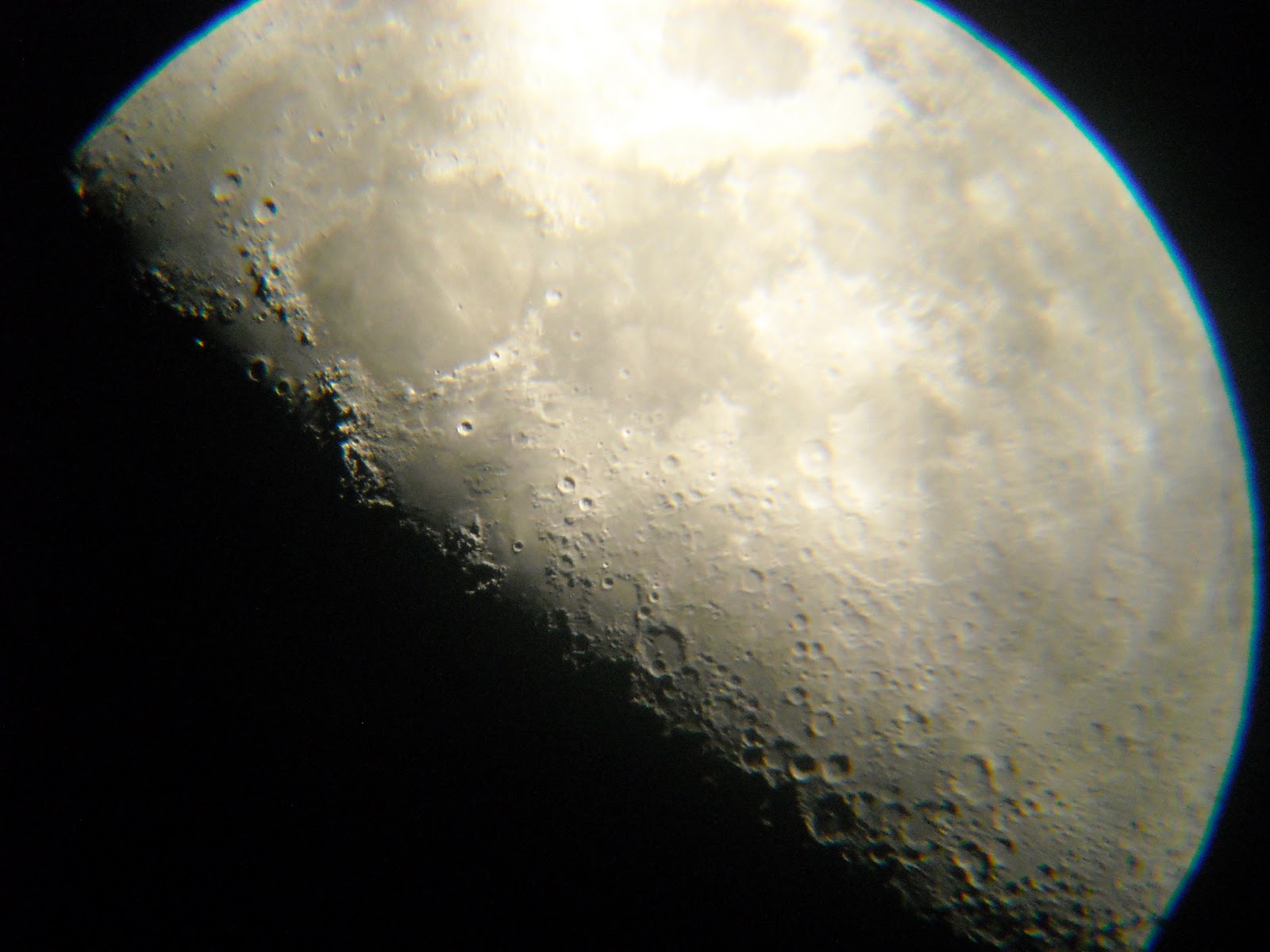
After quite some time of taking a break from the moon, I again return to this eerie object that pierces the serenity of the night sky. But this time its not just observing that I did. I also tried some astrophotography featuring the moon. As you can recall before, I had previous posts (
Photos of the moon and
A tribute to the Moon) of moon pictures using a webcam held directly over the eyepiece. Now with a new camera generously given by my friend Rafael del Rosario, I try taking pictures of our world's nearest neighbor.
Here is the list of the equipment that I used during the observation and photography:
My 60 mm f/15 equatorially mounted refractor
22 mm Huygenian Eyepiece
Nikon Coolpix L16 Digital Point and Shoot Camera
Generic Camera Tripod from CD-R King
Patience and Determination
To give you an idea of what my setup is, here is a photo showing the equipment's arrangement :
The setup is very straightforward - once I have set up the telescope, I just position the camera and adjust its tripod in a way that it will align with the eyepiece. After that, I check the LCD screen of the camera if the image of the moon can be seen clearly without vignetting or darkening at the corners like the ones I took before. When everything looks fine, I take the photos. I am sure that anyone with a digital camera, a telescope and a tripod for their camera can take astrophotos of the moon and planets.
After a few adjustments and trial shots, I came up with these shots of the moon.
And finally, a landscape picture with the moon (but in a portrait orientation) joined by Jupiter which is the bright star North East of the bright moon.
In my opinion, good astrophotography is possible with even the most basic equipment. Of course capturing photos of galaxies and star clusters are not possible with my setup due to the lack of a manual exposure but its not a loss to try what you can do with equipment available to you just like the way I did.