Thursday, June 24, 2010

Sketching on the eyepiece

Here are some sketches using the 4.5 inch reflector. The sketches feature the M6 and M7 open star clusters.

Here is a sketch of M6

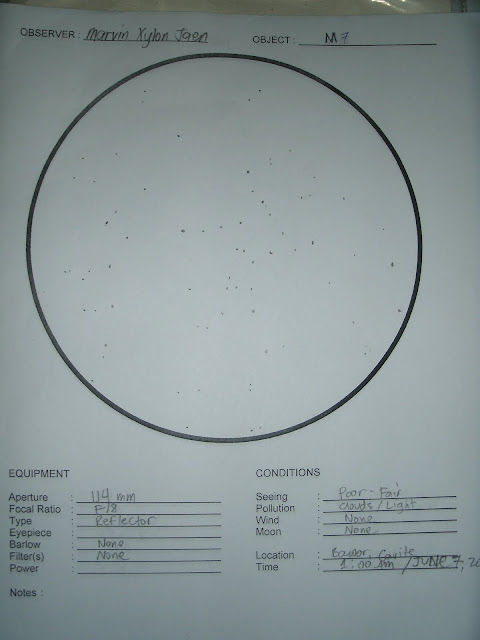
Here is a sketch of M7

A Gallery of my Equipment

In a few months time since formally started my astronomy hobby, I have collected a humble set of equipment which have enabled me to enjoy the heavens created by God for us to explore. In the course of my hobby, I have learned to maximize my tools and study how everything from eyepieces to collimation to the use of the german equatorial mount works. I think the most important lesson here is that never let your equipment limit what you can do. I started out with a 60 mm refractor with a few eyepieces and I have had great fun exploring different celestial bodies. Now that I have upgraded to a 4.5 inch reflector, I think that its time for a new adventure with the cosmos.

P.S. If you want to explore the universe through the telescope, you can visit absindex and watch out for his new products as well as auctions!

Just to rekindle the times, I did this gallery for everyone to enjoy and look at.

My two telescopes side by side

My lovely reflector

My first telescope - the equatorially mounted 60 mm refractor

My 2x Barlow and my eyepieces.

The star diagonal and two more eyepieces

Equipment Review

The reflector is a very stable platform for planetary observation as well as deep sky hunting. The optics of the telescope performs flawlessly. The same is true with the equatorial mount, providing a stable cradle for the telescope which is very important when observing at high power.

I won the auction for this telescope with a customized dobsonian mount but being more comfortable with the equatorial mount, I made arrangements with absindex for the inclusion of an equatorial mount with additional charge of course.

Here is the package that I got :

4.5 inch - f/7.89 reflector with .965 focuser and 5x24 finderscope.
German equatorial mount with setting circles and tripod.
25 mm Huygenian eyepiece and a 12.5 mm eyepiece (to be given soon)
Custom made dobsonian mount.

Here are some photos of the reflector :

The equatorial mount is very sturdy. 

 The degree indicator.

 The declination axis.

 The right ascension axis.

 Overall, a very beautiful telescope.

Performance

The Skycore M115R reflector performs well on all kinds of observation that I did.

Planetary observation is a joy in this telescope. The higher aperture allows me to use higher powers without sacrificing contrast and detail. Saturn is again a very lovely object to look at using 150x power (my highest achievable power using the 6mm eyepiece without barlow). Jupiter also shows up well at 36x power, adorned by its bright moons. Looking at Jupiter at low power is also an enchanting experience for me. Its 4 jovian moons floating around the gas giant presents an eerie scene for me. Moving up again to 150x power, Jupiter begins to show some detail like its cloud belt. However, I cannot compare the images in my telescope with other professional telescopes of 6 inch aperture and above. 

During a side by side planetary test, the reflector gave brighter views of saturn and jupiter. The setup I used for the reflector was a 9 mm and 6 mm eyepiece while for the reflector, I used a diagonal and the 9 mm and 6 mm eyepiece. This may seem like a biased test since more glass (the star diagonal) is being introduced to the light path of the refractor. However, I also put into consideration that the reflector still has a secondary mirror obstructing the light path. 

The reflector stood up well while the refractor started to break up the images at 150x power. It may be the seeing conditions for the night but I believe that the aperture contributes a lot to the amount of power and intricacy of detail that a telescope can handle .

Observing open star clusters is also a joy with this telescope. When I did a side by side test with the 60 mm refractor, the reflector yielded brighter images with more stars that the refractor using a 22 mm eyepiece for both telescopes and without a diagonal for the refractor. 

To compare the difference between the refractor and the reflector, here are my sketches of M6 and M7 using the two different telescopes.

M6 with the reflector (June 7, 2010)

M6 with the refractor (April 8, 2010)

M7 with the reflector ( June 7, 2010)

M7 with the refractor ( April 8, 2010)

I think that these comparisons are pretty definitive by itself. A larger aperture means more light can be collected, thus we get more detail.

One problem that I have encountered with the reflector is that I cannot use my 2x barlow to get more power. Apparently, the barlow that I have is rather long and I need more inside focus for me to get a sharp image. I was adviced by guys from cloudynights to use a short barlow lens to solve the problem.

Another problem is the finderscope of the reflector. It is an entry-level 5x24 finderscope which is not really sufficient for locating star clusters and other deep sky objects but it is adequate when locating bright stars and planets. To solve this, I "borrow" the finderscope of my refractor which is of excellent optical quality to find star clusters and just recently, globular clusters.

Apart from these problems, the telescope is a very good performer. I think I'll be enjoying the use of this telescope for the months or perhaps years to come. 

Tuesday, May 11, 2010

Amateur Astronomy Tutorial

My new Amateur Astronomy Tutorial is under construction and hopefully will be up soon. Here, I will try to share everything that I have learned so far in my personal exploration of the cosmos. I also thank Mr. Alex Lacson for supporting me in pushing through with this blog.

You can visit it here:

http://marvinastronomytutorial.blogspot.com/


Here is the content outline of the blog:

Prologue

I. Finding your way into astronomy.

A. Getting acquainted with the night sky.

a.1 Constellations and stars
a.2 Star Charts

B. Equipment for astronomy

b.1 Eyes
b.2 Binoculars
b.3 Telescopes
b.3.1 Refractor
b.3.2 Reflector
b.3.3 Schmidt – Cassegrain
b.4 Mountings
b.41 Alt-Azimuth Mount
b.4.2 Dobsonian Mount
b.4.3 German Equatorial Mount
b.5 Eyepieces, Diagonals and Barlows
b.5.1 Eyepieces
b.5.2 Diagonals
b.5.3 Barlows
b.6 Other important tools for astronomy

C. Observation Begins

c.1 Observing without a telescope
c.2 The moon through a telescope
c.3 The Planets
c.4 Deep-Sky objects

D. Limiting Factors in Observing

d.1 Clouds
d.2 Light Pollution
d.3 Trees and Structures
d.4 Wind and Bugs

II. Amateur astronomy in the Philippines

A. Local Orgaizations and Clubs
B. Where to buy equipment
C. The Philippine night sky

Epilogue


Let's all hope that this blog tutorial will be a success. I hope to hear from fellow amateur astronomers soon!

Monday, April 12, 2010

Sketching on the eyepiece

Here are some new sketches that I did during my free time this week. Once again, these are open star clusters. Sadly, they seem to be the limit of my humble telescope when it comes to deep sky hunting. I tried hunting globular clusters twice but all I saw was a small round patch of light. I guess a 60mm telescope can't resolve globulars. But anyway, open clusters are fun too so I think its worth hunting anything that's available for the nights to come. The featured DSOs are the Pleiades Star Cluster and the M6 and M7 open star cluster using my custom made sketching template

Please click the image to enlarge.


Monday, April 5, 2010

Hosting a Public Stargazing Session

11 PM, April 4, 2010

While on vacation and observing one night on the church where I stayed, a group of altar servers came up and saw me observing. Curious, they asked if they could have a look and they began touching the telescope and peeking through it. However, the children were also scheduled to serve on a particular church celebration for one hour so I told them to return after their service and I'll let them see the moon and Saturn. So I quickly moved to another location to set up and host a little stargazing or shall I say, moon and Saturn gazing session for the enthusiastic children.

The feeling of hearing their "oohs" and "aahs" gave me so much joy that evening. It is truly wonderful to share the beauty of the cosmos with other people, especially children (in my case, I love children). Even with such humble equipment, I am proud that I was able to give them a good time and a closer glimpse at the world beyond ours.

The experience was truly wonderful and memorable - I cannot express how happy I am when I saw and heard their reactions upon seeing the moon and saturn. It makes me want to do more public stargazing sessions in the future especially in remote places where children only see the cosmos through books and hear them in stories of their teachers. I did this impromptu stargazing session somewhere in General Trias, Cavite ( a little town called Javalera, the home of the Our Lady of Guadalupe Church where I was staying for the Holy week). I think I did my part in the Global Astronomy Month and in sharing the beauty of the heavens through a telescope to other people. For more details about the Global Astronomy Month, visit this:

http://www.astronomerswithoutborders.org/index.php/projects/global-astronomy-month.html

Here are some photographs taken with a 1.3 megapixel mobile phone camera without proper lighting around so the images are quite dark and grainy. A small LED lamp was used to give some illumination.

Equipment used :

60mm - f/15 achromatic refractor
2x Barlow Lens and 90 degree diagonal
Salvaged Binocular Eyepiece


A group picture

My first sketches

While observing one night, I decided to sketch the objects that I have selected for the night. Its a fun and fulfilling way to record and file my observations (for me). Its hard estimating the magnitudes and distances between stars and how to put them on paper altogether. But I think I did a good job for my first time ^_^

Note : Click to enlarge image


Here's a sketch of the famous Orion Nebula


M44 Open star Cluster

The M41 Open star cluster


Here's a sketch of sun spots via solar projection method.This time, I used my custom made sketching template.